
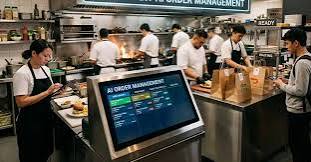
Independent restaurant owners know their business cash cycle intimately: heavy weekends, quiet midweeks, supplier deliveries that must be paid before the weekend revenue arrives, and payroll that falls due regardless. What they know far less well is their own personal cash cycle, because it is driven by the same rhythm and yet almost never examined separately. The owner draws money when the business has it and skips the draw when it does not. The household absorbs the volatility that the business generates.
AI forecasting tools, which many owners already use loosely for the business, can be turned toward the owner’s personal finances with surprisingly little extra effort. This is how to do it, and why it changes the experience of running a restaurant.
The Owner’s Hidden Volatility
A restaurant that is profitable over a year can still leave its owner short in any given fortnight. Revenue is concentrated on two or three nights a week. Costs are spread across every day. When a slow week coincides with a large supplier payment or an equipment repair, the owner’s draw is the first thing cut, because it is the only cost the owner controls unilaterally.
The household, meanwhile, has rent, school fees, insurance, and groceries on their own schedule. When the draw is skipped, those costs are covered from personal savings, a personal card, or not at all. Over a year, the owner’s household has quietly become the restaurant’s shock absorber, and nobody has measured the cost.
Step One: Forecast the Business Honestly
Most owners have a mental model of the business cycle. An AI assistant with access to the point-of-sale data, bank accounts, and supplier invoices can turn that model into a weekly forecast: expected revenue by day based on trailing patterns and seasonality, known costs by due date, and the projected low point of each fortnight.
The forecast will confirm what the owner suspects and add precision. The midweek low in the second and fourth weeks of the month is real, and now it has a number.
Step Two: Forecast the Household Separately
Connect the owner’s personal accounts and give the assistant the household’s fixed costs, their due dates, and the intended draw. Ask for a parallel weekly forecast for the household. Then ask the assistant to overlay the two: which weeks does the business forecast show it cannot support the intended draw, and what does the household forecast look like in those weeks?
This overlay is the picture the owner has never seen. It shows, in advance, the weeks when the household will be squeezed by the business.
Step Three: Smooth the Draw
The fix is a fixed draw, paid on a schedule, sized to what the business can sustain on average, with a business reserve built from strong weeks to fund the draw through weak ones. The assistant calculates the sustainable figure from history and recommends the reserve size needed to cover the worst fortnight of the past year.
Building the reserve takes time. Until it exists, the overlay at least gives the owner weeks of warning rather than days, which changes the options available.
Step Four: Plan for the Repair
Restaurant equipment fails without warning, and the failure is always urgent. A cooler that stops working loses inventory by the hour. This is the most common source of a sudden personal cash demand for owners, because when the business cannot cover the repair, the owner does.
The assistant can maintain a dedicated equipment reserve, funded by a small fixed weekly transfer, and track it separately from both the operating cushion and the household. It can also model what happens if a repair of a given size arrives in a given week, so that the owner knows in advance whether the reserve, the business, or the household would bear it.
When the Forecast Shows a Gap Nothing Covers
Some weeks the overlay shows a genuine gap: the business is short, the reserves are thin, and a household cost cannot move. The assistant’s role is to present the options with costs, not to choose.
Business-side options include asking a supplier for a week’s extension, which often works and costs nothing, or drawing on a business line of credit arranged in advance. Household-side options include delaying a discretionary cost, using a personal card and clearing it after the weekend, or using a short-term liquidity option and paying a fee for speed. Fees for that last category vary widely by provider. In Korea, where small restaurant owners frequently rely on card-based cash services to bridge midweek gaps, providers are typically compared through Korean-language resources such as 희망뱅크 before committing. The principle for any owner is to know the fee before the cooler fails, and to compare it against the cost of the supplier extension that might solve the problem for free.
Monday Morning, Ten Minutes
Owners who adopt this system describe the same routine. Monday morning, before service prep, they read two forecasts and one overlay. Most weeks, nothing needs a decision. Some weeks, a call to a supplier or a shifted payment date solves a problem that would otherwise have arrived on Wednesday. Occasionally, a real gap requires a real choice, made with a week’s notice and the costs written down.
The kitchen is still the heart of the business. The forecast is what lets the owner go home from it without carrying the business’s volatility into the household, week after week, season after season.